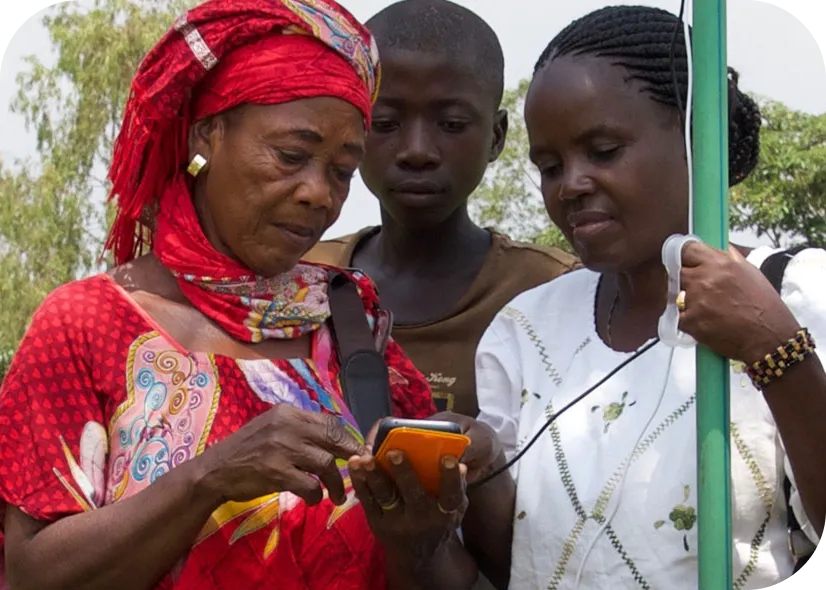

At Cadasta, data belongs to the people who create it.
Our technology, training, and support services put control of land and resource data firmly in the hands of our partners and the communities they represent.We follow rights-based, community-led decision-making grounded in:
Together, these frameworks guide us in protecting privacy, strengthening self-determination, and ensuring that data serves communities, not the other way around.
Land and resource data can carry real risks if misused, particularly when it reflects collective rights, customary governance systems, or sensitive territorial claims.
Strong data governance helps reduce the risk of harm, supports transparency and accountability, and ensures that data strengthens community rights rather than exposing communities to new vulnerabilities. At Cadasta, responsible data practices are foundational to trust, self-determination, and long-term impact.

Every Cadasta project begins with an open dialogue to determine what data will be collected, why, and any sensitivities or restrictions. Cadasta does not collect data. All data collection is managed by the partner.
Our partners lead the Free, Prior, and Informed Consent processes. Consent must be ongoing and can be withdrawn at any time. All agreements are documented before data collection begins.

Long-term data sovereignty requires more than consent and control; it also depends on sustainable systems and clear choices over time. Digital mapping platforms, storage, security, and technical support incur real costs, whether proprietary or open source. To support continued access beyond the life of a project, Cadasta provides partners with transparent options to continue using the platform in sustainable ways or to transition their data elsewhere.
To ensure responsible stewardship, Cadasta sets reasonable limits on data volume and usage while working closely with partners to manage data efficiently and transparently. These limits are not about restriction. They are part of an ethical approach to governance that balances community control with long-term viability, while ensuring partners remain informed and in control of what happens to their data after a project ends.
Cadasta takes data protection seriously.
Our approach combines global best practices with community-level training and accountability.
All data encrypted in transit and at rest, with role-based permissions and partner-specific project spaces.
We work only with providers who meet SOC 2, ISO 27001, and FedRAMP certification standards.
No access, analysis, or sharing without explicit consent. Public reports use only aggregated and anonymized data.
Capacity Building: We provide partners with training on secure data collection, privacy-conscious workflows, and risk mitigation.
Partners decide whether and how their data is shared.
You control whether information stays private, is shared within your network, or becomes public through maps, dashboards, StoryMaps, printed maps, or reports.
Cadasta does not permit third-party access to partner data, including for commercial purposes, unless partners explicitly authorize it.
Good metadata protects rights and improves transparency.
We encourage partners to record key details: what the data shows, when and how it was collected, who created it, and under what conditions it can be used. Clear documentation helps preserve data integrity and community ownership for the long term.
After that you can:
If no action is taken, we will securely archive the data for five years before permanently deleting it. Support packages and à la carte options (accounts, credits, storage, and hours) are detailed in our Partner Sustainability Pathways.
If the partner chooses, Cadasta will provide two years of continued access to the platform at no cost, followed by your choice of options. If no response is received, Cadasta securely archives data for up to five years before deletion.
Every community deserves the right to control its own data.
If you’d like to discuss applying your own community data protocols, consent workflows, hosting options, or exit plans, we’d love to hear from you.
A proud member of the Corus International family.