


By: Leah Kellenberger
Across 12 countries, Cadasta’s Strengthening Land and Forest Rights (SLFR) Program, funded by the UK International Development, from the UK government, is partnering with 13 organizations to advance secure land and forest rights for Indigenous Peoples and local communities. This program aims to secure management or ownership rights for forest-dwelling communities, as communities living within the forests are in the best position to steward them, safeguarding critical ecosystems, strengthening livelihoods, and contributing to climate solutions.
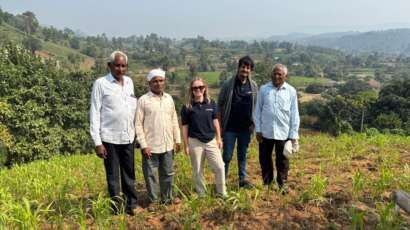
In late 2025, I traveled to Dediapada in Gujarat, India, where our long standing partner, ARCH-Vahini, has been working with forest-dwelling communities for more than 30 years. What I saw put into sharp focus the impacts that secure land and forest rights can have, not only on individual livelihoods and village economies, but also on broader goals of environmental stewardship, climate resilience, and national development priorities.
Transforming Land Tenure: The Forest Rights Act and Local Realities
For generations, millions of Scheduled Tribes (STs) and Other Traditional Forest Dwellers (OTFDs) across India have been excluded from formal land governance, leaving custodians of the forests treated as “encroachers” on their own ancestral lands, limiting their access to and use of the rich and vast resources. That began to change with the passage of The Scheduled Tribes and Other Traditional Forest Dwellers (Recognition of Forest Rights) Act, 2006, commonly referred to as the Forest Rights Act (FRA), that marked a significant legal shift in India’s land governance framework by formally recognizing both individual and community rights to land and forest resources that they had long depended on.
Under the FRA, communities can secure ownership of land cultivated before December 2005, and can claim rights to non-timber forest products (NTFPs), grazing, fishing, and community forest resource rights. Critically, the law affirms the authority of Gram Sabhas (village assemblies) to protect and manage forests sustainably. While millions of land titles have already been issued nationwide, implementation remains uneven.
Gujarat’s experience, particularly in Dediapada and neighboring areas, is distinctive precisely because of the pioneering role of ARCH-Vahini and community leadership in pushing the FRA from legislation to tangible land security.
ARCH-Vahini: Longstanding Advocacy Meets Innovative Local Action
Since 1988, ARCH-Vahini has worked alongside tribal communities in Gujarat, building trust through education, health, research and rights awareness. After the FRA’s passage, ARCH-Vahini shifted from advocacy to implementation, mobilizing this framework helping communities navigate what can often be a complex and technical process. ARCH-Vahini colleagues, Ambrish and Trupti Mehta, recognized that effective claims required evidence that both communities and authorities could trust. Using handheld GPS devices combined with Google’s satellite imagery, they trained villagers to map the boundaries of fields and forests themselves. This approach strengthened claims with clear, verifiable data and was accepted by state authorities.
ARCH-Vahini’s leadership was also strategic in addressing bureaucratic delays. When early approvals in Dediapada were low, and many claims were rejected, ARCH-Vahini took the matter to court through a Public Interest Writ Petition. The Gujarat High Court ruled that satellite images and maps prepared through other authorized imagery sources should be considered valid evidence for land rights claims. This judicial milestone helped remove a major barrier for communities, enabling them to claim their rights on stronger grounds.
Scaling Impact through Collaborative Mapping
Since 2020, Cadasta has partnered with ARCH–Vahini in rural Gujarat, working with more than 84,000 families and households over 5,000 villages across the state to digitize, standardize, and scale community efforts. This collaboration led to the mapping of over 60,000 hectares of forestland and supported the issuance of over 16,000 claims.
Cadasta’s role has focused on making the process more consistent, accessible, and scalable. Our technology enables accurate field mapping with mobile devices, with easy to use interfaces and forms configured in local languages. The platform captures both geospatial points and the tabular data from communities needed to accompany claims. We ensure that the spatial and demographic data is securely stored , creating the foundation for strong governance and data driven decision-making. By involving community members directly in data collection and storage processes, we foster local ownership and engagement, keeping community members at the center.
Tangible Transformations and Investment
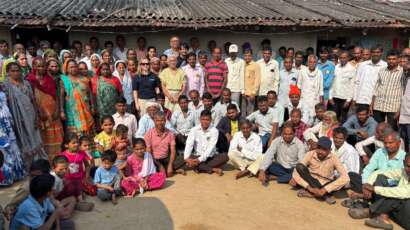
Conversations with Gram Sabha representatives from 20 villages in Dediapada brought fresh insights into how secure land rights are changing village economies:
- Investments in irrigation systems, including solar-powered pumps and new boreholes, have boosted agricultural cycles from once to multiple harvests per year, increasing productivity by up to five-fold in some areas.
- Increased productivity has led to higher yields, in many cases tripling household incomes and enabling reinvestment in land and higher quality inputs.
- Villagers now routinely store three years’ worth of grain, strengthening food security and resilience to climate variability.
- Greater crop diversity and more crop cycles throughout the year have led to more biodiversity and an increase in wildlife returning to cultivated landscapes.
These outcomes show what secure land rights can unlock. When communities have recognized ownership of their land and forests, they invest for the future, simultaneously building economic stability, food security, and ecological stewardship. All of these pieces come together with land rights serving as the basis for holistic and sustainable community development.
Linking Secure Tenure to National Priorities: Reforestation, Energy, and Resilience
This work addresses larger national and global priorities. According to the Food and Agriculture Organization’s Global Forest Resources Assessment 2025, India has over 70 million hectares of forestland, ranking ninth in the world for total forest area and third in net annual forest gain.
These national gains demonstrate progress towards India’s broader commitments to sustainable development and climate action. In 2019, Prime Minister Narendra Modi inaugurated COP14 in New Delhi with a pledge to restore 26 million hectares of degraded land by 2030. In February of 2020, the Prime Minister launched the Formation and Promotion of 10,000 Farm Producer Organizations, with the goals of increasing farmer incomes and providing access to higher quality inputs and better access to markets. At COP26 in 2021, India announced a long-term goal of achieving net-zero carbon emissions by 2070, with aggressive expansion of renewable energy capacity, including a target of 500 Giga Watts of non-fossil energy by 2030, and accelerated deployment of solar and wind infrastructure. In 2022, India submitted its Intended Nationally Determined Contributions under the Paris Agreement, committing to creating an additional carbon sink of 2.5 to 3 billion tonnes of CO2, equivalent through expanded forest and tree cover, by 2030.
In Gujarat, we see how secure land and forest rights help communities organically contribute to these national and international commitments across these main areas:
- Climate and Ecological Restoration: Community-managed forests are remaining intact and increasing levels of biodiversity.
- Agricultural and Energy Production: Secure land and resource rights provide the confidence for long-term investments in irrigation and renewable energy systems, boosting agricultural productivity, enhancing resource management, and could lead to higher levels of food security and dietary diversity.
- Economic Resilience: Stewardship in the land requires time and financial investment, which leads to higher outputs to markets and, in turn, leads to higher incomes, reducing poverty and ensuring financial security for individuals and households.
Tenure as a Catalyst for Resilience and Systems Change
Our visit to Gujarat underscored a critical insight: secure land and forest rights can change a community’s, and in turn, a country’s trajectory. When rights are recognized, anchored in participatory documentation, community organizations, and supportive legal frameworks, communities unlock the stability to plan, invest, and grow. In doing so, they contribute not only to their own prosperity but to national and international goals for a more resilient and equitable planet.
The journey from rights awareness to formal recognition, made possible by ARCH-Vahini’s decades-long advocacy and Cadasta’s technology partnership, demonstrates how secure tenure catalyzes investment, productivity, equitable governance, and environmental stewardship for the long term
Scaling these efforts, with sustained support from donors, governments, and technical partners, these gains reached 14 districts in Gujarat. Scaling this work can strengthen forest governance, expand rural food security, advance India’s climate commitments, and extend rights-based development to millions more forest dwelling families.
Secure land and resource rights are not the end goal, they are the foundation of prosperous, resilient, and thriving communities.